





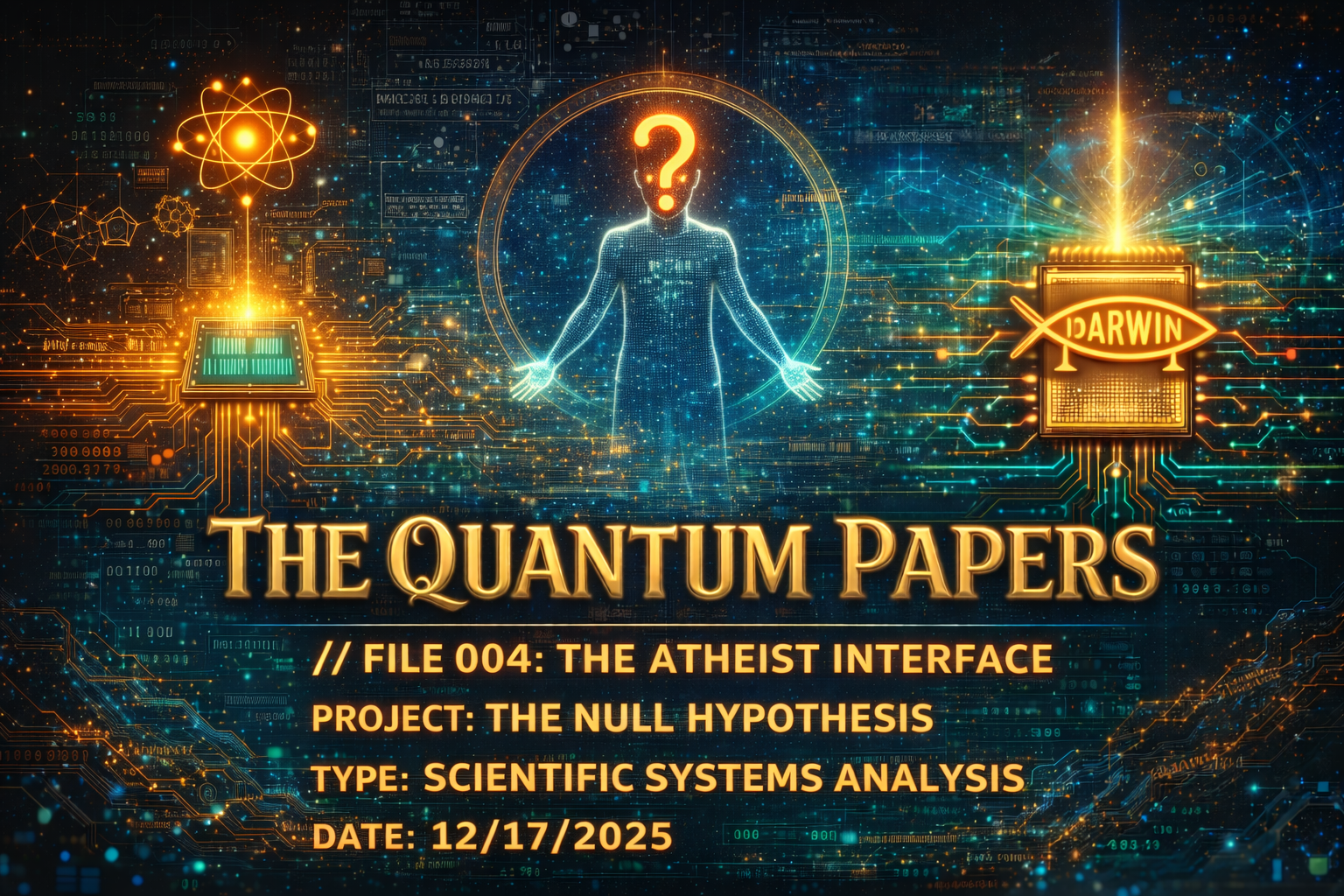
QTM 104What do the Atheists Really Believe?
What Do Atheists Believe?
To the skeptic, the materialist, and the truth seeker:
What do atheists believe? This is not a sermon. It is an honest look at the ideas and the evidence.
For a long time, the Church has treated atheism as an emotional problem—anger, rebellion, or a desire to sin. That may be true for some, but not for the thoughtful skeptic. Most modern atheists are not running away from God; they are running toward reason.
They stand on the shoulders of thinkers like Carl Sagan, who famously said: "Extraordinary claims require extraordinary evidence."
Atheists argue that believing in a "sky daddy" without proof insults the intellect. They look at the universe—cancer, tsunamis, silence, and confusion—and refuse to accept "magic" as an explanation. They want evidence.
So let us grant the skeptic their premise: we should not believe anything without evidence. But here is the twist. When we look at what science has actually found—the laws of thermodynamics, physics, and the way life works—the evidence no longer points to a random accident. It points to a Mind.
1. The Skeptic's View
Before we look at the evidence for God, we need to understand the alternative. The skeptic's view (often called materialism or naturalism) is that only matter and natural laws exist—no God. To engage fairly, we have to see the world the way they do:
1. Matter is All There Is
- The premise: Everything we see comes from unguided physical processes. There is no "supernatural."
- The argument: This is not always said with anger; sometimes it is said with wonder. As the astrophysicist Neil deGrasse Tyson famously stated, "We are stardust." In this view, we are not spiritual beings created by God; we are made from the stuff of stars. We are connected to the universe by chemistry, but we have no purpose beyond what we choose for ourselves.
2. Time + Chance = Everything
- The premise: Given enough time, chaos will eventually turn into order without a guide.
- The argument: "It sounds impossible that life started by accident, but we are dealing with Deep Time. As the physicist Edward Tryon said, 'Given enough time, the impossible becomes possible, the possible probable, and the probable virtually certain.' Given 14 billion years, hydrogen gas eventually turns into people."
3. No Design (The Illusion)
- The premise: The appearance of design in the universe (like the eye or the star) is a trick of evolution.
- The argument: "The human eye looks engineered, but it wasn't. It started as a light-sensitive spot and evolved over millions of generations. As Richard Dawkins argues in 'The Blind Watchmaker,' biology is the study of complicated things that give the appearance of having been designed for a purpose, but actually weren't."
This is a fair, robust hypothesis. But like any hypothesis, it must fit the data. If the data contradicts the hypothesis, the honest scientist must abandon the theory. And right now, the data is breaking the theory.
2. The Battery Problem: Where Did the Universe Come From?
For centuries, atheists took comfort in the idea of an "eternal universe"—one that had always existed.
- The argument: If the universe has always been there—stretching infinitely into the past—then it does not need a Creator. It just is.
- The reality: If that were true, God would be unnecessary. But in the 20th century, physics made two discoveries that undercut this idea.
2.1 The Law of Entropy (The Dying Battery)
The Second Law of Thermodynamics is one of the most tested laws in science. It says that in a closed system, usable energy always goes down. Disorder (entropy) always goes up.
Think of the universe like a giant battery. Stars burn fuel. Energy spreads out. The universe is slowly winding down toward "heat death" (everything runs out).
The logic: If the universe were eternal (infinite past), the battery would have run out an infinitely long time ago. We would be in the dark. The fact that the sun is still shining shows the universe was "charged up" at some point in the past. It has a start date.
2.2 The BGV Theorem
For a long time, skeptics tried to avoid the Big Bang by suggesting "bouncing universes" (endless cycles) or "eternal inflation." But in 2003, three leading cosmologists—Arvind Borde, Alan Guth, and Alexander Vilenkin—published the BGV Theorem.
They proved, with math, that any universe that is expanding (on average) over its history cannot have existed forever in the past.
How did they show this?
Think of rewinding a video of an explosion. As the video plays forward, things fly apart. When you rewind, they move back together. The BGV Theorem shows you cannot rewind forever. Because the universe is expanding, going backward in time you eventually hit a point where the math breaks down. You run out of time. There was a beginning.
What is a "space-time boundary"?
It is the moment when time begins—the start. That is a problem for atheism: you cannot have a "natural cause" before nature exists. If the boundary is the beginning of nature, the cause must be outside nature—supernatural.
3. Fine-Tuning: The Universe's Settings
If the origin of the universe is a problem for the skeptic, the structure of the universe is an even bigger one.
Physicists have found that the universe depends on a specific set of numbers—things like the speed of light or the mass of an electron. Think of the universe like a huge control board with about 30 knobs. Each one has to be set to a very precise value for the universe to work at all.
3.1 How Precise Are the Settings?
Look at just two of these "knobs" to see how precise they have to be.
Knob 1: The force of gravity (1060)
This controls how strongly matter pulls on other matter. It is set to a precision of 1 part in 1060.
Picture this: Imagine a tape measure stretching across the whole observable universe (14 billion light years). If the "gravity setting" were off by just one inch, stars would not exist. No stars, no planets, no life.
Knob 2: The cosmological constant (10120)
This controls how fast space itself expands (dark energy). It is set to 1 part in 10120.
Picture this: This number is so precise it is hard to imagine. It is like throwing a dart from the edge of the universe and hitting one single atom on Earth.
3.2 The Witness: Fred Hoyle
This evidence is so strong that it shakes even the most committed atheists. Sir Fred Hoyle was the Cambridge astronomer who coined the term "Big Bang." He was a staunch atheist. But when he discovered the fine-tuning required to create Carbon inside stars, he was stunned.
"A common sense interpretation of the facts suggests that a superintellect has monkeyed with physics, as well as with chemistry and biology, and that there are no blind forces worth speaking about in nature."
3.3 The Penrose Number
Sir Roger Penrose, a Nobel Prize winner, calculated the odds of the universe starting in a state that could support life. The number is 1 in 1010^123—astronomically small.
To picture it: imagine a firing squad of one billion sharpshooters aiming at your heart from ten feet away. They all fire. They all miss. Would you say, "Wow, I got lucky"? No. The odds are so low that "chance" is not a good explanation. You would assume they missed on purpose. The universe is not a lucky accident; it is set up.
4. DNA: The Code of Life
Finally we come to one of the strongest pieces of evidence: life itself. We used to think a cell was a simple blob. Today we know it is more like a city—and at the center is a "library" that holds the most complex instructions in the universe: DNA.
4.1 The Information Problem
DNA is not just "like" a code. It is a code. It uses four "letters" (A, C, T, G) to store the blueprints for every living thing. Here is the problem for the materialist: Matter does not create code.
Physics can create patterns (snowflakes, sand dunes), but it does not create information in the sense of a message. If you see ripples on a beach, you think of wind. If you see "JOHN LOVES MARY" written in the sand, you think of a mind.
4.2 The Math of Life (The Protein Problem)
To see why "chance" cannot explain life, look at the building blocks: proteins.
Here we do not mean the shake you drink at the gym. In biology, a protein is a tiny, complex machine that does specific jobs in the cell. A protein is built by chaining together chemicals called amino acids.
- Think of Amino Acids like letters of the alphabet (there are 20 of them).
- Think of a Protein like a sentence.
- To make a functional protein, you have to arrange about 150 of these "letters" in the exact right order.
Protein folding:
Getting the order right is only half the battle. Once the chain is built, it must fold. The string of amino acids has to twist and fold into a precise 3D shape. If it folds wrong, it is useless.
The Math:
The probability of a single functional protein forming by chance—getting 150 amino acids to line up in a sequence that will fold correctly—is calculated at 1 in 10164.
Why this matters: This calculation is just for ONE protein. A single simple cell requires 300 to 500 distinct proteins to function. Materialism cannot even explain the first brick (the protein), let alone the cathedral (the cell). To believe this happened by accident is the mathematical equivalent of believing an explosion in a print shop could accidentally assemble a dictionary.
4.3 The Multiverse Idea
Faced with these odds, the committed atheist has a hard choice. They cannot deny the math. So to keep their view of the world, they often point to the multiverse—the idea that there are countless other universes.
This is not a fringe idea. Leading atheists like the late Stephen Hawking and Leonard Susskind have relied on it. Susskind admitted that without the multiverse, physicists would struggle to explain fine-tuning without an intelligent Designer.
The problem:
Look at what this view costs. To explain the precision of our universe without God, the materialist has to suppose an infinite number of universes we can never see. They reject one unseen God for lack of "physical proof," but accept trillions of unseen universes for which there is also no physical proof.
4.4 The Honest Skeptics Who Changed Their Minds
Not every atheist was willing to accept that trade-off. When faced with the evidence from DNA and fine-tuning, some of the world's most famous atheists did something unexpected: they changed their minds.
- Antony Flew (The "Pope of Atheism"): For 50 years, he was the intellectual heavyweight of Atheism. In 2004, he announced he believed in God because of the DNA evidence. He stated: "The only satisfactory explanation for the origin of such 'end-directed,' self-replicating life as we see on earth is an infinitely intelligent Mind."
- Allan Sandage (The Astronomer): The father of modern astronomy concluded: "The world is too complicated in all its parts and interconnections to be due to chance alone."
5. Morality: Where Do Right and Wrong Come From?
We have looked at the universe, the laws of physics, and the code of DNA. Now we have to ask about what runs in us: morality—our sense of right and wrong.
5.1 The "Is-Ought" Problem
Science can tell us what is (gravity, cell division). But science cannot tell us what ought to be. On a strictly materialist view, "evil" does not really exist. Atoms are not evil. If humans are just "advanced animals," then murder and rape are just strategies. We may not like them, but we cannot call them "evil"—only "unpopular."
5.2 The Nuremberg Dilemma
Atheists often argue: "We don't need God. We have a Social Contract. We vote on what is right and wrong."
There is a fatal flaw in this logic, and history exposed it in 1945. At the Nuremberg Trials, the Nazi leaders argued a chilling defense: "We broke no laws." They argued that everything they did was legal under the laws of the Third Reich. They were obeying the "Social Contract" of their nation.
The Chief U.S. Prosecutor, Robert H. Jackson, argued that this defense was invalid. He appealed to a "Higher Law"—a Law of Humanity that transcends the laws of any King, Dictator, or Government. The Tribunal agreed. This established that Morality is Objective (Real), not Subjective (Opinion).
5.3 The Atheist's Admission
The famous atheist philosopher J.L. Mackie admitted this problem in his "Argument from Queerness." He admitted that if objective moral values existed, they would be "entities of a very strange sort, utterly different from anything else in the universe."
5.4 The Source of the Standard
You cannot have a Moral Law without a Moral Lawgiver. The fact that we feel this Law pressing on our conscience—judging us even when we don't want it to—is proof that we are not just biological accidents. We are moral agents accountable to a Judge.
6. Conclusion: The Return to Reason
"The first gulp from the glass of natural sciences will turn you into an atheist, but at the bottom of the glass God is waiting for you." — Werner Heisenberg
6.1 Reversing the "God of the Gaps"
For years, atheists accused believers of using a "God of the Gaps" argument—using God to explain what Science hadn't solved yet. But the exact opposite has happened. We are not arguing for God based on what we don't know. We are arguing for God based on what we do know.
- The Evidence: The BGV Theorem. Science proved the universe has a hard start date. Anything that begins to exist must have a Cause. The Cause must be Spaceless, Timeless, and Immaterial.
- The Evidence: The Penrose Number (1010^123). The initial entropy is fine-tuned to a level that makes "Chance" impossible. Complex precision never arises from an explosion; it only arises from Intent.
- The Evidence: DNA (10164). Life runs on digital code. Matter creates patterns, but never Code. DNA is a signature of Intelligence.
The more we learn about the universe, the harder it becomes to be an atheist. The "gaps" are not closing; the evidence is piling up.
6.2 The Final Verdict
When you set aside the emotion and look at the evidence, you are left with four clear facts:
- Cosmology: The battery is running down. Someone must have charged it.
- Physics: The dials are set. Someone must have set them.
- Biology: Life runs on code. Someone must have written it.
- Morality: The law is written on our hearts. Someone must be the Judge.
The Bible anticipated this conclusion thousands of years ago: "For every house is built by someone, but God is the builder of everything." (Hebrews 3:4).
To look at the universe—its fine-tuned settings, its genetic code, and our sense of right and wrong—and say it all built itself is not reason. It is blind faith. The evidence is in. The Designer is real.