







QTM 103What do the Jews Really Believe?
What Do Jews Believe?
To the children of Israel, the people of the Book, and my own flesh and blood:
What do Jews believe? I write this as a son of the tribe. I am Ashkenazi, from the line of Abraham, Isaac, and Jacob. I was not raised in a strictly observant home, but the ways of our people—the Talmud and the Kol Nidre—are part of who I am. I love the Torah. It is the ethical bedrock of Western civilization.
But as someone who cares about evidence, I have to look at our tradition honestly. When I look at modern Judaism, I see a disconnect. We cherish the Torah, yet what we follow today looks nothing like what Moses gave us. The heart of it has been changed, and most of us never asked when or why.
I am not asking you to leave your Jewish identity. I am asking you to see the full picture.
"I will give you a new heart and put a new spirit in you..." (Ezekiel 36:26)
1. The Broken Altar
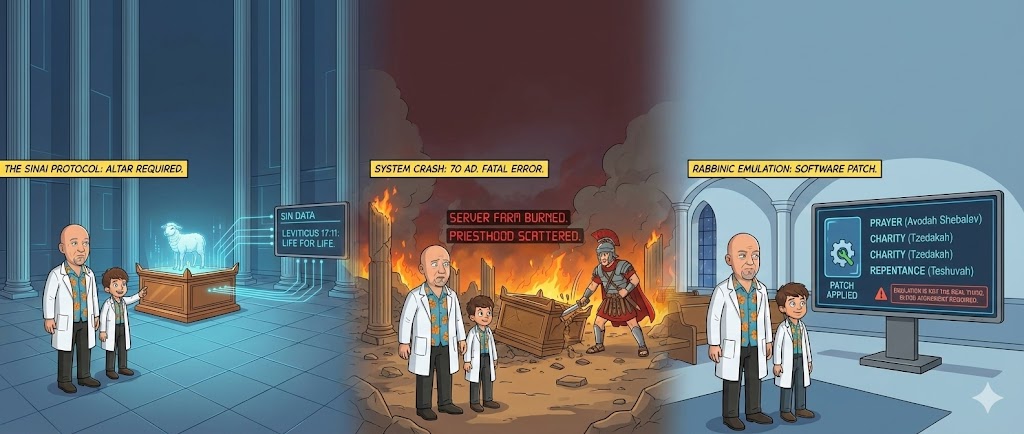
To understand the crisis, we have to look at the "agreement" in the Torah. The Law of Moses was not just a philosophy; it was a covenant with specific steps.
What the Torah says (Leviticus 17:11):
The Torah is clear about how sin is dealt with:
"For the life of a creature is in the blood, and I have given it to you to make atonement for yourselves on the altar."
The rule (Deuteronomy 12:13-14):
God also added a limit. You could not offer a sacrifice just anywhere. It had to be done "only at the place the LORD will choose" (the Temple in Jerusalem).
So: You need blood to atone for sin. You need the Temple to offer the blood.
1.1 The Catastrophe (70 AD)
In 70 AD, the Roman General Titus breached Jerusalem. Josephus, the First Century Jewish historian, records in The Jewish War (Book 6, Chapter 2) the exact moment the "Tamid" (the daily sacrifice) ceased. He notes that on the 17th of Tammuz, the priests ran out of lambs, and for the first time in centuries, the smoke on the altar stopped. Days later, the Temple was burned to the ground.
What that means:
This was not just a tragedy; it was a catastrophe for the faith. The way the Law required people to atone—through the Temple—was gone. The Torah demands a sacrifice, but the one place God allowed it was destroyed. The Jewish people could no longer keep that part of the agreement.
1.2 The 40-Year Window (30 AD – 70 AD)
That raises a crucial question: Would God let His only chosen place for sacrifice be destroyed without providing a replacement first?
In Jewish theology, there is a principle called Makdim Refuah Lamakah—God always prepares the cure before He allows the wound. If the Temple was the "wound," where was the cure?
History shows a precise 40-year window:
- 30 AD: Jesus of Nazareth establishes a "New Covenant" at his Last Supper, claiming His blood is the new atonement.
- 70 AD: The Romans destroy the physical Temple, ending the old atonement system forever.
What God had already said:
Long before this happened, the Hebrew Scriptures said that the old covenant (the one with Moses) was not meant to last forever. God promised that a new one was coming.
"The days are coming," declares the LORD, "when I will make a new covenant with the people of Israel and with the people of Judah. It will not be like the covenant I made with their ancestors when I took them by the hand to lead them out of Egypt." (Jeremiah 31:31-32)
What Jeremiah said would change:
Jeremiah did not only predict a different covenant; he predicted a better one. He spelled out how it would work:
- From the inside: "I will put my law in their minds and write it on their hearts" (v. 33). The old way was external (stone tablets); the new way is written on the heart.
- Forgiveness that lasts: "For I will forgive their wickedness and will remember their sins no more" (v. 34). The old way required a yearly day of atonement (Yom Kippur); the new way promises sins remembered no more.
So what does that mean?
The destruction of the Temple in 70 AD fits with the idea that the old system had been replaced by the new one—the one Jeremiah predicted and the Messiah began. The fact that we cannot offer sacrifices today is not God failing; it is consistent with His promise that a new covenant would take over.
2. The Council of Jamnia

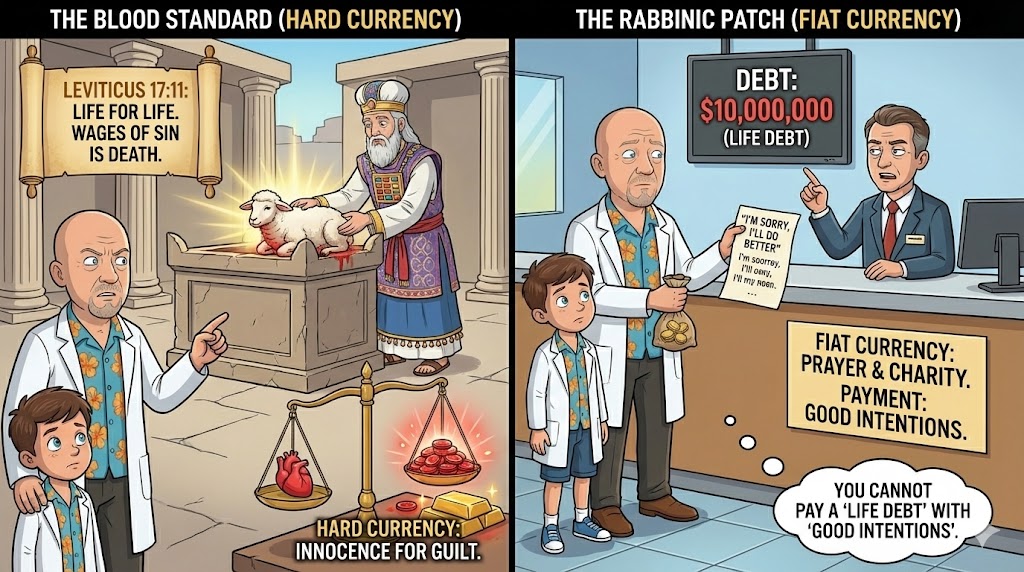
Today, if you ask a rabbi how we are forgiven without a Temple, they will say that prayer (Tefillah), repentance (Teshuvah), and charity (Tzedakah) have replaced the sacrifice.
But we have to ask: When did that rule change? It is not in the Torah.
2.1 What Happened at Yavneh
After the Temple fell in 70 AD, the Jewish faith was in crisis. Without the altar, the main way the religion had worked was gone. A famous leader, Rabbi Yohanan ben Zakkai, set up a new center for Jewish life in the city of Yavneh (Jamnia). It was there that the "new rules" were decided.
We actually have the historical record of the moment this shift happened. It is recorded in Avot D'Rabbi Natan (4:5):
Once, as Rabban Yohanan ben Zakkai was coming forth from Jerusalem, Rabbi Joshua followed after him and beheld the Temple in ruins.
"Woe unto us!" Rabbi Joshua cried, "that this, the place where the iniquities of Israel were atoned for, is laid waste!"
"My son," Rabban Yohanan said to him, "be not grieved; we have another atonement as effective as this. And what is it? It is acts of loving-kindness, as it is said, For I desire mercy and not sacrifice."
2.2 Who Had the Right to Change It?
This is the turning point. In that moment, a human leader said that "good deeds" were now as good as the "blood atonement" God had commanded.
The problem:
Rabbi Yohanan may have wanted to save the people from despair, but he did not have the right to rewrite what God had said.
God said: "The life is in the blood... I have given it to you to make atonement." (Leviticus 17:11).
The rabbis said: "We have another way."
That shift moved Judaism from being built on what God said in the Torah to being built on what the rabbis taught. The Torah clearly required blood atonement; the new teaching said good deeds could take its place. But nowhere in the Torah does God say that charity pays the debt of sin. Only life pays for life.
3. The Daniel Timeline
Most people think the Messiah could arrive at any random moment in history. But if we look at the Hebrew Prophets, that is not true. The Messiah had a specific arrival time.
The Prophet Daniel, writing from Babylon, gave a specific countdown known as the "70 Weeks" prophecy (Daniel 9). He didn't just give a vague era; he started a stopwatch.
3.1 The 69 Weeks
In Daniel 9:25, the angel Gabriel gives Daniel the timeline:
"From the time the word goes out to restore and rebuild Jerusalem until the Anointed One, the ruler, comes, there will be seven 'sevens,' and sixty-two 'sevens'."
Here is the math:
1. The Unit: In Hebrew prophecy, a "seven" (Shebuim) is a period of 7 years.
2. The Duration: 7 + 62 = 69 sets of 7 years.
3. The Total: 69 x 7 = 483 Years.
The Prophecy states that from the command to rebuild the walls of Jerusalem, there would be exactly 483 years until the Messiah appeared.
3.2 The Calculation (To The Day)
We know from history (Nehemiah 2) that the command to rebuild the walls was given by the Persian King Artaxerxes Longimanus on March 14, 445 BC.
However, the Biblical prophetic calendar uses a 360-day year (not our 365.25 solar year).
* 483 years x 360 days = 173,880 days.
If you start at March 14, 445 BC and count forward exactly 173,880 days, you arrive at April 6, 32 AD.
What happened on April 6, 32 AD?
This was the 10th of Nisan—the very day the Passover Lamb was selected. It was the day Jesus rode a donkey into Jerusalem (Palm Sunday). For the first time in his ministry, He allowed the crowds to hail him as King. He fulfilled the timeline to the exact day.
The Mathematical Summary
The Prediction: Daniel predicted the Messiah would arrive 483 biblical years after the command to rebuild Jerusalem.
The Start Date: March 14, 445 BC (Decree of Artaxerxes).
The Duration: 173,880 Days.
The Arrival Date: April 6, 32 AD (Palm Sunday).
The Accuracy: This is not a vague guess. It is a mathematical lock to the specific era, and arguably the specific week, of Jesus's passion.
3.3 What the Timeline Requires
We can step back and see what the text and history actually require.
- First: The prophet Daniel predicted a specific period between the command to rebuild Jerusalem (445 BC) and the arrival of the Messiah. Counting forward 483 biblical years puts the arrival in the early first century (about 30–33 AD).
- Second: The text says the Messiah must arrive and be killed before the destruction of the Temple.
"After the sixty-two 'sevens,' the Anointed One will be put to death... The people of the ruler who will come will destroy the city and the sanctuary." (Daniel 9:26)
- Third: The city and sanctuary were destroyed by Titus in 70 AD.
- Fourth: The Talmud records a harsh reaction to those who try to calculate these dates: "Blasted be the bones of those who calculate the end" (Sanhedrin 97b).
So what does that mean?
The prophecy in Daniel 9 is not open-ended; it has a built-in deadline. The Messiah had to appear before the Temple was destroyed. So we are left with two possibilities: Either the window closed in 70 AD with no Messiah (and the prophecy was not fulfilled), or the Messiah did arrive in that window, as predicted, but was not recognized at the time.
4. The Talmudic Witness
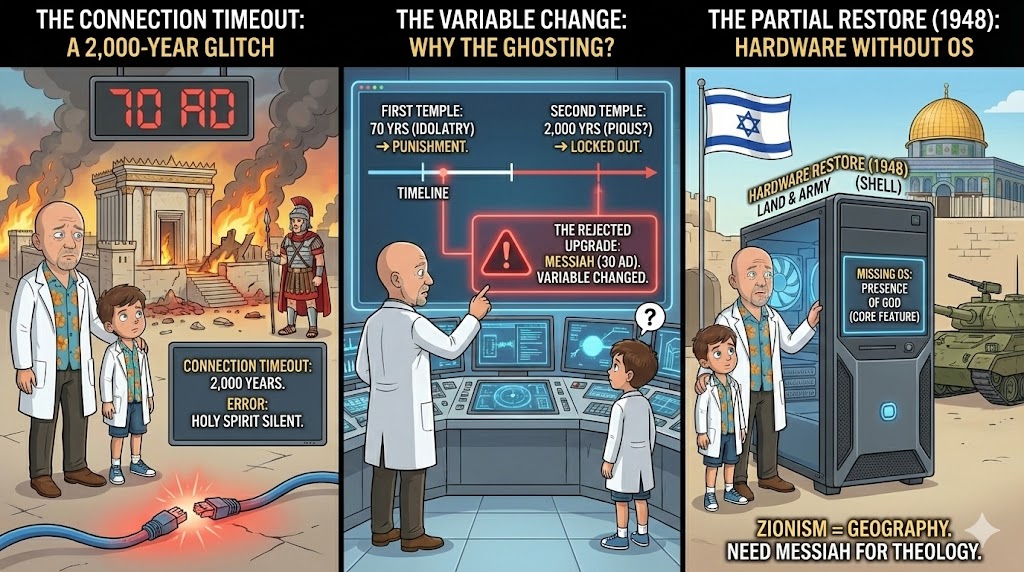
This is one of the most striking pieces of evidence. It does not come from the New Testament; it comes from the Babylonian Talmud, the central text of rabbinic Judaism.
The Talmud says that in the 40 years before the Temple was destroyed, something unusual happened in the sanctuary. To see why that matters, you need to know what normally happened.
4.1 How It Worked
On Yom Kippur, the High Priest did the "scapegoat" ritual (Leviticus 16). He took a strip of crimson wool and divided it.
One piece was tied to the horns of the scapegoat, which was sent into the wilderness to carry the sins away.
The other piece was tied to the door of the sanctuary (or sometimes a rock in the wilderness, with signal flags).
The piece on the door was the public sign—the signal for the whole nation.
Based on Isaiah 1:18 ("Though your sins are like scarlet, they shall be as white as snow"), people expected that when the goat was pushed off the cliff in the desert—meaning the sins were carried away—the wool on the Temple door would turn white.
4.2 Was It a Trick?
A skeptic might ask: "Maybe the priests just dipped it in bleach? Maybe it was a chemical trick to control the masses?"
We have to look at the Motive and the Chemistry.
1. The Chemistry Problem:
In the ancient world, bleaching wool was a slow process. It involved soaking fabric in lye, sulfur fumes, or leaving it in the intense sun for days. The Talmud describes a phenomenon that happened in "Real Time"—at the moment the goat was pushed in the wilderness. There was no known chemical agent in the first century that could instantly turn crimson wool snow-white in front of a crowd without destroying the fabric.
2. The motive problem:
This is the strongest point. If the High Priests were faking the miracle to keep people happy, why would they stop faking it for the last 40 years?
The priests in the first century (mostly Sadducees) were often corrupt. They wanted to keep order. It would have helped them to keep faking the miracle so people would think God was still pleased with the Temple.
To say the thread stayed red for 40 years was to admit they had lost their connection with God. That would hurt their standing.
So: Corrupt leaders usually fake success, not failure. The fact that they recorded their own failure for 40 years suggests they were seeing something they could not control or fake.
4.3 The History of the Signal
The Talmud (Yoma 39b) describes this over three periods:
Era 1: The Golden Age (Approx. 200 BC)
This era corresponds to the priesthood of Shimon HaTzaddik (Simon the Just). Simon was a giant of history. He was the High Priest and the last survivor of the "Great Assembly." The Talmud records that his piety was so great that during his 40-year tenure, the crimson thread turned white every single year.
Note: In a random situation (like a coin toss), the odds of getting the same result 40 times in a row are about 1 in a trillion. That kind of "streak" would be effectively impossible without something beyond chance.
Era 2: The fluctuating period (200 BC – 30 AD)
After Simon died, the spiritual state of the nation declined. The miracle became inconsistent. The Talmud says: "Sometimes it turned white, and sometimes it remained red." The result varied, depending on the current High Priest.
Era 3: The Hard Stop (30 AD – 70 AD)
Then, the pattern changed drastically. The Sages record:
"Our Rabbis taught: During the last forty years before the destruction of the Temple... the crimson thread did not turn white."
So what does that mean?
This was no longer up and down. It was 40 years in a row of "red."
The math: 70 AD (when the Temple was destroyed) minus 40 years is 30 AD.
The event: 30 AD is when Jesus was crucified.
According to the Talmud, the moment Jesus died, the "Old System" stopped validating the animal sacrifices. The Red Thread stayed red because the final Scapegoat—the Messiah—had already carried the sins away once and for all.
5. The Two Profiles of the Messiah
Why did our ancestors miss Him? In the First Century, the Jewish world was under Roman occupation. The people were desperate for a Conquering King to crush Rome. They focused entirely on the prophecies of glory and ignored the prophecies of suffering. But if we look at the data honestly, the Hebrew Prophets described two completely different profiles.
5.1 Two Different Pictures
The Scriptures present a puzzle that has troubled readers for centuries.
Profile A: The Suffering Servant
The Prophets described a humble figure who arrives quietly and dies for the sins of the nation.
"Rejoice greatly, Daughter of Zion!... See, your king comes to you, righteous and victorious, lowly and riding on a donkey..." (Zechariah 9:9)
"But he was pierced for our transgressions, he was crushed for our iniquities... and by his wounds we are healed." (Isaiah 53:5)
Profile B: The Conquering King
The Prophets also described a warrior who arrives from Heaven to defeat Israel's enemies and rule the world.
"In my vision at night I looked, and there before me was one like a son of man, coming with the clouds of heaven... He was given authority, glory and sovereign power..." (Daniel 7:13-14)
5.2 The Rabbinic Struggle
The tension between these two profiles is undeniable. How can the Messiah be a dying servant and an eternal king? Later Rabbinic tradition realized this contradiction was so sharp that they developed a theory of Two Messiahs:
1. Mashiach Ben Yosef (Messiah Son of Joseph): Who suffers and dies in battle.
2. Mashiach Ben David (Messiah Son of David): Who rules and reigns.
The Talmud explicitly discusses this mourning for the suffering Messiah in Sukkah 52a:
"The verse [Zechariah 12:12] is interpreted as a eulogy for Mashiach ben Yosef who is killed."
The Sages saw the data required a death. They just assumed it had to be a different person.
5.3 One Way to See It: Two Peaks
There is a simpler way. It is not two different Messiahs. It is one Messiah with two arrivals.
Imagine standing on a plain and looking at a mountain range. You see two massive peaks that look like they are right next to each other. But if you hiked to the first peak, you would realize there is a massive valley—a long span of time—separating it from the second peak.
The Valley of Time:
The Prophets saw the events (The Suffering and The Reigning) but they couldn't see the timeline separating them.
- Arrival 1 (30 AD): Jesus came as the Suffering Servant to deal with the internal problem (Sin). He rode the donkey (Zech 9:9), but he also fulfilled the grim prediction of Daniel 9:26:
"After the sixty-two 'sevens,' the Anointed One will be put to death and will have nothing."
The Hebrew word used here is Yikaret ("cut off"), a technical term often used in the Torah for the death penalty or violent excision. He didn't just die; He was executed to pay the debt. - Arrival 2 (Future): He will return as the Conquering King to deal with the external problem (Evil/War). He will fulfill Daniel 7 by arriving on the clouds to rule.
5.4 The Modern Shift
You may be wondering: If the "Two Messiah" theory is in the Talmud, why have I never heard it in synagogue?
What changed in history:
After the rise of Christianity and the failed revolt of the false messiah Bar Kokhba (132 AD), Jewish leaders shifted their teaching. To separate Judaism from the growing Christian movement, the idea of a "dying Messiah" (Ben Yosef) was played down and eventually pushed to the edges of Jewish thought.
What many believe today:
Today, mainstream Judaism often focuses on the Conquering King (Ben David) or reads the "Suffering Servant" passages as about the nation of Israel, not one person. In many Reform and Conservative circles, belief in a personal Messiah has been replaced by the idea of a "Messianic Age"—a time of peace and progress through human effort.
So what does that leave us with?
We have a choice. We can accept the modern reading that removes the suffering individual, or we can look back at what Daniel and Isaiah actually say—a specific person who dies before the Second Temple falls.
6. Conclusion
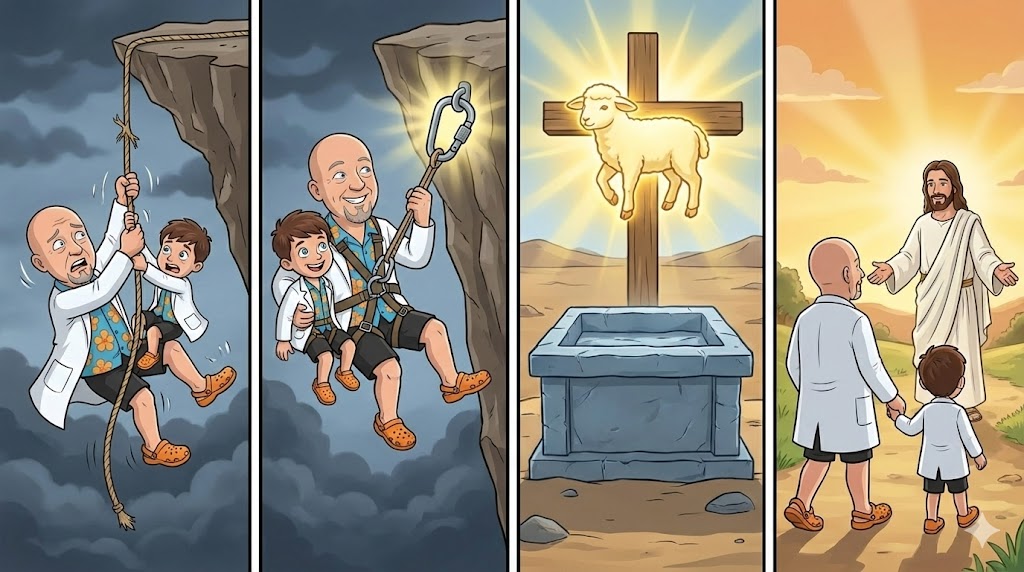
I understand the hesitation. For a Jewish person to consider Jesus, it can feel like betrayal. Like leaving the tribe to join the "other side."
But if we set aside emotions and look at the evidence, a clear picture appears. We have two separate lines of evidence—one from Babylon (Daniel) and one from Jerusalem (the Talmud)—that point to the same moment in history.
1. The Timeline (The Math)
The Prophet Daniel (9:25) started a countdown of 483 years from the command to "restore and rebuild Jerusalem."
History records two major decrees issued by the Persian King Artaxerxes. You can look at the text and decide which one fits the prophecy.
Exhibit A: The Ezra Decree (457 BC)
- The Text: "Artaxerxes, king of kings, to Ezra the priest... You are sent by the king... to inquire about Judah and Jerusalem with regard to the Law of your God... And you, Ezra, in accordance with the wisdom of your God... appoint magistrates and judges to administer justice to all the people of Trans-Euphrates." (Ezra 7:12-26)
- The Case: This decree restored the judicial and religious authority of Jerusalem (restoring the city as a governing capital).
- The Result: Counting 483 years from this date lands at 27 AD (The start of Jesus's ministry/His Baptism).
Exhibit B: The Nehemiah Decree (445 BC)
- The Text: "I said to the king, 'If it pleases the king... send me to the city in Judah where my ancestors are buried so that I can rebuild it.' ...And I said to the king, 'If it pleases the king, may I have letters to the governors... and a letter to Asaph... so he will give me timber to make beams for the gates of the citadel... and for the city wall.'" (Nehemiah 2:5-8)
- The Case: This decree authorized the physical reconstruction of the walls and gates.
- The Result: Counting 483 (prophetic) years from this date lands at 32/33 AD (The Triumphal Entry/Palm Sunday).
The Verdict:
Regardless of which decree you believe fits the text better, the countdown expires in the exact same 5-year window. The math lands squarely on the life of Jesus of Nazareth.
2. The Hostile Witness (The Talmud)
Our own Sages recorded in the Babylonian Talmud (Yoma 39b) that the Yom Kippur miracle—the crimson thread turning white—stopped working "40 years before the destruction of the Temple."
- The Math: 70 AD minus 40 years lands us in 30 AD.
- The Convergence: Whether the specific year was 30, 32, or 33 AD, both our Prophecy (Daniel) and our Oral Tradition (Talmud) agree that the "Old System" expired and the "Messiah Event" occurred in that specific window.
3. The Profile (The Suffering Servant)
While we expected a Conquering King, the Prophets also described a Suffering Servant.
- Isaiah 53: Predicted he would be "pierced for our transgressions" and "cut off from the land of the living."
- Daniel 9: Predicted the Anointed One would be "put to death and will have nothing."
The data requires a Messiah who dies to pay a debt, not just a King who rules.
4. The Promise (The New Covenant)
The Prophet Jeremiah explicitly predicted that the Mosaic Covenant (The Law on Stone) was never meant to be permanent.
"The days are coming," declares the LORD, "when I will make a new covenant with the people of Israel and with the people of Judah... I will put my law in their minds and write it on their hearts. I will be their God, and they will be my people." (Jeremiah 31:31, 33)
God promised a specific shift: moving the Law from external tablets to the human heart and offering permanent forgiveness.
The invitation:
I do not expect you to accept all of this at once. This is a heavy topic, and it challenges centuries of tradition.
But I do invite you to look at the evidence for yourself.
Don't take my word for it. Open your own Tanakh. Calculate the 483 years in Daniel 9. Open the Talmud and read Yoma 39b for yourself. Read Isaiah 53 without the commentary and ask who it describes.
If these claims are false, they will crumble under scrutiny. But if they are true, then the Messiah is not a stranger or a traitor. He is the specific solution our Prophets promised, arriving exactly on time.
The evidence is on the table. The conclusion is yours to draw.
The Altar is cold. But the Lamb is alive.